
Speed decides when the next normal turn arrives
SPD controls how quickly a Character moves toward their next normal turn. With everything else equal, a faster ally reaches that turn sooner and takes more turns over a long fight. It does not make each hit stronger or make an animation finish faster.
An earlier turn can mean applying a buff before an attack, healing before an enemy moves, or generating a needed Skill Point. Its value depends on what you do with the opportunity. Extra turns that the team cannot afford are not automatically extra damage.
The action order is a changing queue. SPD is one input; advance, delay, extra actions and special kit rules can change who moves next. An Ultimate or follow-up attack is not, by itself, proof that its owner has reached another normal turn.
Action Value measures the wait
Action Value (AV) is the remaining battle time before an ordinary turn. Lower means sooner. Time passing brings everyone closer to acting; it does not belong exclusively to the Character currently at the front of the queue.
For an unmodified turn, the starting wait is 10,000 ÷ SPD. Think of 10,000 as the full distance to travel and SPD as the rate of progress. After that normal turn, the full distance starts again. The table assumes constant SPD and no other effects.
Scroll horizontally to see all columns.
| SPD | First turn | Second turn |
|---|---|---|
| 100 | 100 AV | 200 AV |
| 125 | 80 AV | 160 AV |
| 134 | About 74.63 AV | About 149.25 AV |
These are elapsed times, not the remaining AV you would see after another unit has acted. At 40 elapsed AV, the 100 SPD unit has 60 AV left to wait. Its turn has not restarted just because someone else moved.
A Speed change changes the remaining wait
A mid-turn SPD buff changes how quickly the remaining distance is covered. In the example above, 40 AV at 100 SPD has used 4,000 of the 10,000 distance. Raising SPD to 125 leaves 6,000 ÷ 125 = 48 AV to wait, rather than starting a fresh 80 AV turn. A slowdown lengthens the wait in the same way.
Build-screen SPD is therefore not the entire picture. Read the in-battle buffs and their duration. A percentage SPD bonus uses base SPD; it is not automatically that percentage of the final number after every Relic contribution.
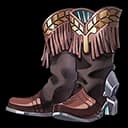
A slot choice, not a universal build rule
Feet pieces can have a SPD main stat. Choosing one trades another possible main stat for earlier turns. This item art identifies the slot; it does not represent a particular rolled piece. See Relic Stats for the available main stats.
Advance moves you along; delay moves you back
Ordinary percentage Action Advance removes part of the full 10,000 distance. Action Delay adds to it. Neither is simply a percentage change to the time currently displayed.
At 100 SPD with 6,000 distance remaining, a 25% advance removes 2,500. The remaining wait becomes 3,500 ÷ 100 = 35 AV. A 25% delay instead produces 8,500 ÷ 100 = 85 AV. These examples isolate one effect; real abilities may combine several.
If an advance would move a unit past the front, the remaining distance stops at zero. The unused portion is not banked for its following turn. Advancing someone already about to act can therefore save less time than advancing them just after they acted.
Read the recipient rules too. Bronya can make an ally act immediately with her Skill, but using it on herself does not grant that immediate extra action. Summons and special actions need their own kit rules.
A breakpoint is a deadline you can meet
The familiar 134 SPD advice comes from fitting two unmodified turns into a 150 AV opening window, as used in Memory of Chaos. The calculation is 20,000 ÷ SPD < 150, so the required SPD is above 133⅓. At 134, the second turn lands around 149.25 AV; at 133, it lands around 150.38 AV and misses that window.
That proves one timing result under stated conditions. It does not prove 134 is the best build for every Character or mode. A different deadline, an advance, a wave transition or a temporary SPD buff changes the problem. Avoid relying on an exact boundary tie or a rounded display number when tuning closely.
Equipment thresholds are a different kind of breakpoint. For example, Space Sealing Station checks for at least 120 SPD to activate its additional ATK bonus. That is a set condition, not a promise of two turns in any particular cycle. Check the relevant Relic set and encounter separately.
Tune the sequence the team needs
Start with an order: apply a debuff, provide the buff, then deliver the important attack. If the support acts after the attacker, raising only the attacker’s SPD may make the sequence worse. A slower advance support can sometimes bring an attacker back immediately after their natural turn; a faster one enables a different plan.
Neither arrangement works without its resource budget. Repeated Skills need Skill Points, and turn-based effects can expire as their owner or recipient acts. Check whose turns an effect counts, not just its stated duration.
A useful upgrade earns an action that matters while preserving enough damage, healing or protection to use it. Trading away essential stats for a theoretical turn that arrives after the fight is decided does not help that clear.
Watch the order you actually play
- Choose the attack or defensive action that needs to happen on time.
- Check the allies and resources it needs beforehand.
- Play the opening manually and watch what changes after buffs, advances and enemy actions.
- Adjust one build at a time, then check the following turn as well as the opener.
Use Character Kit and Guide tabs for the specific rotation, and Team-building Fundamentals to connect that order to the team’s damage plan. The target is a working sequence, not an isolated SPD score.